
 Brazilian Psychotherapist & Author
Sessions usually last around 50 minutes, although this may occasionally vary depending on the process, when previously agreed upon.

Helder Conde
 Brazilian Psychotherapist & Author
For those living far from home, yet longing to be close to themselves. Therapy in English and Portuguese.
Sessions grounded in a modern psychoanalytic approach, with active listening, genuine interaction, open dialogue, and human connection.
My patients are in several countries 
My Patients
There is no such thing as far away
While we may be so different, we are also profoundly alike.
No matter your nationality, language, ethnicity, gender, or age, we all face challenges, carry wounds, and keep discovering new parts of ourselves. No one is ever fully complete. No one is ever entirely found.
Our emotions deserve a place to rest, regardless of where we come from.
I’m proud to work with Portuguese and English-speaking patients from many different backgrounds and countries.
Here is where they are:
- 🇩🇪 Hamburg, Germany
- 🇨🇦 Toronto, Canada
- 🇶🇦 Doha, Qatar
- 🇫🇷 Paris, France
- 🇮🇪 Dublin, Ireland
- 🇳🇱 Amsterdam, The Netherlands
- 🇵🇹 Coimbra, Portugal
- 🇨🇭 Basel, Switzerland
- 🇺🇸 Atlanta, USA
- 🇺🇸 Boston, USA
- 🇺🇸 Orlando, USA
- 🏴 Edimburgh, Scotland
- 🇧🇷 Campinas, SP - Brazil
- 🇧🇷 Porto Alegre, RS - Brazil
- 🇧🇷 Rio de Janeiro, RJ - Brazil
- 🇧🇷 São Paulo, SP - Brazil
Your emotions, in your language
Psychoterapy in English
Your emotions, in your language
Sessions in fluent English, to people of all nationalities, based on direct interaction and open dialogue, without communication barriers. I've had the Certificate of Proficiency in English from the University of Cambridge, England, for the past 30 years.
English
🇧🇷
Psicoterapia em Português
Suas emoções, na sua língua
Sessões online com abordagem psicanalítica moderna, no idioma em que você pensa, fala e sente. Estaremos conectados por videochamada, com interação direta, escuta ativa e diálogo aberto, para mergulharmos em sua história, pensamentos e emoções, com total privacidade.
PORTUGUESE
It is not because things are difficult that we do not dare; it is because we do not dare that they are difficult.
Seneca, Stoic philosopher and Roman dramatist

About Me
I do believe in change
A good starting point for anyone beginning therapy is to believe in change, understanding that being better is not the same as being perfect. Growth is a process that unfolds step by step, not an event that happens overnight.
Getting to know yourself through speech, what is said and what is heard, is a way to better understand your story, your cognitive patterns, and your emotional dynamics, whether positive or not.
From that point, it becomes possible to better understand your emotions and learn to react to them more maturely. I truly believe that it’s not only emotions that influence our thoughts. The opposite is also true.
I want to walk alongside you, helping you reflect on who you are and what you want for your present and future, making your emotions allies of what you think and of how you consciously choose to act.
Helder Conde

Helder Conde
🇧🇷 Brazilian Psychotherapist & Author
- Psychotherapist | Clinical Psychoanalyst
- 48 years old, married, father
- Co-founder of the websites Nossos Psicólogos, PsicoPosts, and PsicoCanva
- Author of the book Histórias que os Rostos Contam (Stories That Faces Tell), available in Portuguese.
- 30-year certification with Certificate of Proficiency in English (CPE), by the University of Cambridge, England
I have deep appreciation for words and their effects. I believe they have the remarkable power to illuminate certain “things” (ideas, traumas, patterns, feelings, solutions, explanations) that need to be contemplated and acknowledged in our journey as human beings.
In my nearly fifty years of life, I have come to the conviction that we are made not only of what we feel but also of what we think. I’m certain we are not merely reactive beings, dealing with reality solely through spontaneous and often uncontrollable emotional responses.
These emotions, of course, exist and they deserve to be respected and heard. But especially when they’re out of balance, emotions need a counterweight: self-regulation, the ability to shape one’s own thoughts and behaviors in order to achieve goals and maintain balance in the face of challenges. And that is something one learns and cultivates.
It’s about clarity, seeing where problems truly lie and identifying the possible ways to address them. It’s about understanding your role in reality and in the events that unfold, especially when they affect you more than you would like. And it’s also, undoubtedly, about recognizing where the problems don’t lie, so you can deal with them more effectively and specifically, without turning everything into one giant, unsolvable issue.
This requires the ability to recognize in your own life the foundations, the strengths and inner resources, the ones you’ll use to create positive change and live better. It also requires willingness to break harmful patterns and to review your own convictions, as well as the labels you assign to others and to yourself.
And more: it calls for a commitment to doing all this with generosity, understanding your story, accepting your limitations, valuing your talents, and making sense of why things are the way they are, and why others act the way they do.
It’s about growth, not perfection. It’s about accepting cycles, endings and new beginnings, highs and lows, sunny days and cloudy nights. It’s about being at peace with life’s imperfections without giving up on making it better.
Together with my wife and life partner, Solange Maia, who is also a psychoanalyst, I wrote the book “Stories That Faces Tell” (“Histórias que os Rostos Contam”, available in Portuguese), born from the practice of looking at the faces of strangers to inspire fictional stories that speak about all of us. After all, this entire journey of growth is also about better understanding others, and recognizing within ourselves a little of the pain, the love, the fears, the struggles, and the humanity that make us so alike, even in our differences.
Some say that every word has already been spoken. But no one has spoken your word yet.
Mia Couto, Mozambican author

Psychotherapy| Psychoanalytic Therapy

The Ensō is this circle, created with a single brushstroke, representing, in Zen tradition, the journey of self-awareness and transformation while preserving the essence of who we are.
It symbolizes the beauty of imperfection and the courage to look within, recognizing that life does not demand perfection, but presence, acceptance, and continuous movement.
That same compassionate, empathetic, realistic, and human perspective guides my work. My goal is to help you understand your story, accept who you are, and at the same time become who you wish and deserve to be.
What is Psychoanalysis?
Psychoanalysis, also known as Talk Therapy, is a process that helps us access our deepest emotions and personal narratives, break negative patterns, and reinterpret our own stories so that we can reshape our thoughts and actions in the present.
It is a journey of self-care that looks at you with calm and attention, helping you raise your level of awareness and gain clarity, to reach a place of lightness, inner peace, and psychological well-being.
In my sessions, I follow a modern psychoanalytic approach that involves direct interaction. You are, of course, the main character in this process, but I will also speak, offer reflections, and invite you to take new perspectives. I will not be a mere listener or spectator during our sessions. I will be your companion along the way!
I don’t know your story yet, but I know that much of who you have become, what you feel, what you think, what you avoid, and what you long for has to do with it.
There may have been pain, helplessness, doubt, or a reality you couldn’t change. Maybe there was a lack of embrace, just as there was a lack of encouragement. There may have been absences and silences, or perhaps noise and excess.
Your journey hasn’t followed a straight line, I know. But it is precisely in the curves of the path that valuable lessons may be hidden, lessons that psychotherapy can help reveal.
The act of speaking, listening to your own thoughts, and opening yourself to reflection can be part of a process of change that puts your well-being, not your pain, at the center.

What does Psychoanalysis treat?
Psychoanalysis is based on the idea that not everything we feel and think is conscious. There is an unconscious mind where desires, memories, and conflicts are stored, and even though they lie beyond our awareness, they still influence our lives and the way we relate to others.
Psychoanalytic sessions are precisely an opportunity to take time to look within, at your emotions, thoughts, and behaviors, with the goal of expanding your self-awareness and bringing to consciousness what has been hidden. This allows for new choices, greater emotional freedom, and a more authentic way of living.
I’ll do my best to offer you an empathetic, non-judgmental space for active conversations and direct interaction, helping you in your reflections with full respect for your own rhythm.
Our online sessions will be moments of re-signification, where you can speak openly about your problems, emotions, doubts, and most intimate feelings, in complete confidentiality.
Each process is unique and will be guided in a fully individual way, based on the issues that matter most to you.
- Anxiety and Stress
- Sadness
- Depression
- Emotional Dependence
- Relationships
- Loss and Grief
- Loneliness
- Emotional Emptiness
- Resentment
- Emotion Suffering
- Trauma
- Self-Esteem and Self-Image
- Self-Knowledge
- Fears
- Career
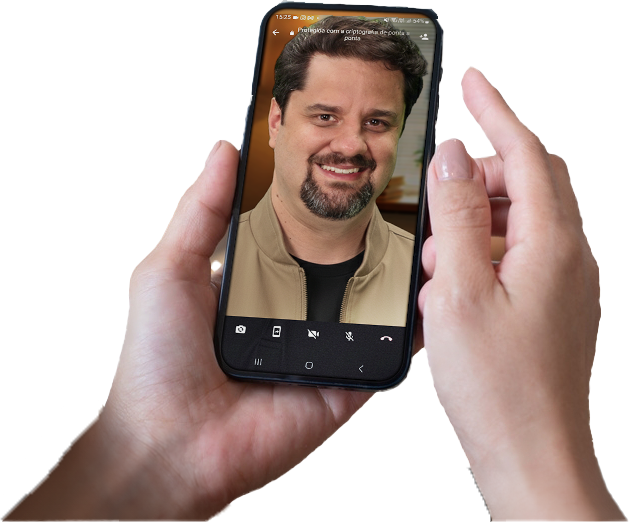
Schedule your Online Session
Our sessions will always be held with the camera on, so that we can see and hear each other. No session will ever be recorded.
Sessions last between 50 and 60 minutes and are based on open dialogue, within a modern psychoanalytic approach in which you speak, but also listen to what I have to share with you. We will be partners in this journey of well-being and self-knowledge. Shall we?
Being happy is a great responsibility. Few people have the courage to.
Adélia Prado, Brazilian author

Frequently Asked Questions
Questions about
INDIVIDUAL ONLINE THERAPY
Psychoanalysis is a deep journey of self-knowledge and emotional healing. In this process, we explore thoughts, feelings, and unconscious patterns, renewing behaviors and, most importantly, bringing positive changes to your daily life.
The process is personalized and individual. We will move forward together on this journey, within a safe and welcoming space. Not only does Psychoanalysis address symptoms, but also seeks to understand the unique complexity of your life story, your thoughts, emotions and relationships.
It is a partnership committed to your well-being, to promoting meaningful and lasting transformations. I’ll be delighted to accompany you on this journey of self-care, growth, and emotional balance.
The psychoanalytic therapeutic process is recommended for anyone who wishes to have a healthier relationship with themselves and with others.
It helps you better understand your emotions, thought patterns, and behaviors, allowing you to make changes that lead to a life of greater well-being and balance.
Online sessions are held through video call platforms such as WhatsApp or Google Meet, always with the cameras on. This allows for real-time dialogue through speech and constant visual contact.
It is important that you are alone in a quiet environment, with full privacy, free from interruptions or distractions. The use of headphones is recommended.
For the best audio and video quality, it is preferable to use a Wi-Fi connection during the session.
You can use either a computer or a mobile phone, preferably on a stable surface, so that you do not have to hold it during the session.
No session is ever recorded, ensuring the confidentiality and privacy of the conversations.
The session fee will be agreed upon individually, according to the frequency, duration, and chosen payment schedule (per session, monthly, or quarterly).
Payments are settled in advance, via PayPal or credit/debit card (via Stripe platform).
Sure! Sessions are completely confidential and are never recorded under any circumstances.
It is the psychoanalyst’s duty to maintain professional confidentiality in order to protect each patient’s privacy, never disclosing their name or any identifying information, even to other professionals in the field, without prior written consent.
We follow strict ethical and professional conduct codes that ensure that no topics discussed or information shared will ever be disclosed, except in rare cases required by law, such as when there are threats to personal safety or to others.
This varies according to each person’s emotional state and availability.
It is generally recommended to have at least one session per week, so that the reflections and insights remain active within you, supporting the development and progress of the psychoanalytic process.
However, throughout the process, the ideal frequency can be discussed, reviewed and adjusted, according to your needs.
The duration of the individual psychoanalytic process varies for each person and is shaped by their specific needs. There is no predefined period or fixed deadline to “complete” the process.
Some processes last a few months, while others may continue for years.
Keep in mind that psychoanalysis involves looking into your personal history and your deepest issues to foster lasting transformation.
There is no need to rush or compare your process to anyone else’s. It will be uniquely yours, and it is impossible to determine exactly how long it will last.
Nothing will ever be done deliberately to make you uncomfortable. On the contrary, the goal is for you to feel better, not worse.
Psychoanalysis invites you to look at many aspects of your life and your story, at your own pace. At times, intense emotions may surface, reflecting encounters with challenging parts of your experience.
In those moments, yes, some discomfort may arise. But nothing will ever be addressed without your consent or willingness.
Keep in mind that expressing these feelings is very important, as they can lead to meaningful changes in your journey and in the way you perceive your story: past, present, and future.
You will receive the support and care you need during these moments. Discomfort is often a sign that you are touching deep issues and making progress in your therapeutic process.
No. I work with a more contemporary psychoanalytic approach that includes active listening, direct interaction, shared reflections, and open dialogue.
Of course, you will be the main voice in your process and will speak more than I do most of the time. But yes, I will make interventions, suggest reflection, and engage in active conversation with you at any moment during the session, not just at the end.
I will not be a mere observer of your process. If you are looking for a psychoanalyst who participates rather than simply listens, you can be sure that this is exactly how I work.
Psychoanalysis is a therapy through speech: it involves your words, and mine as well.
Online sessions are always paid in advance, so that the appointment can be considered confirmed.
Payment can be made via PayPal or credit/debit card (you will receive a secure link to complete the transaction via Stripe platform).
Since these are recurring sessions, installment payments are not available.
If payment is not made up to two hours prior to the session, the appointment will be automatically canceled.
Yes, all of my individual sessions take place online.
When we begin the process, you will receive all the necessary guidance in advance to ensure that our sessions run smoothly and without any difficulties.
Yes, it is possible to cancel a session as long as the request is made in writing via WhatsApp message at least 24 hours in advance.
In this case, the amount corresponding to that session can be credited toward a future appointment if payment has already been made.
If the cancellation is made less than 24 hours in advance, the payment will not be refunded, since the time slot was reserved for you and there would not be enough time to offer it to another patient.
If I ever need to cancel due to an emergency, I will contact you in advance so we can reschedule the session.
I will wait up to 15 minutes for you to join the session. The session will then proceed within the remaining time, ending at the originally scheduled time, so that my following appointments are not affected.
After this waiting period, the session will be considered completed, and the payment cannot be transferred or credited toward future sessions.
If I am the one who is late, don’t worry: you will be notified, and your time will be fully compensated.

What lies behind us and what lies before us are tiny matters compared to what lies within us.
Ralph Waldo Emerson, North-American philosopher, and poet
My Book

What stories would your face tell a stranger?
Stories That Faces Tell (“Histórias que os Rostos Contam”), available in Portuguese, presents photographs of ordinary people and, inspired by them, creates characters for 22 original short stories born from the skin, the lines, and the shape of every curve and contour. Because there is no one who doesn’t carry, on their face, a secret garden, a hidden place, a deep cave where entire stories can live.
Through this attentive gaze, what lies within each of us is revealed: courage, solitude, longing, fear, desire, and love. Though fictional, these stories are invitations to real life and to emotions so familiar, yet so often repressed, in every human being.
After a while, the image of the other moves us and awakens an almost inexplicable empathy. We no longer see it as the photograph of a stranger. It becomes a mirror. We are, in fact, look at and speaking about ourselves.